
"Water justice" is everywhere now. UN documents, government reports, development agency press releases. But the more a concept spreads, the faster it hollows out.
Fanaian and colleagues' 2025 systematic review combed through 470 peer-reviewed studies from 2012 to 2023. How did the field grow over a decade? Which problems kept resurfacing? And whose solutions were being proposed?
The answers are equal parts promising and unsettling.
The concept didn't deepen — it expanded
In 2012, water justice was mostly a distributional question: who gets how much? Over the following decade the field broadened. Procedural justice arrived — who participates in decisions? Recognition justice arrived — whose knowledge, whose culture counts? From the 2020s onward, decolonization literature accelerated. Rivers are now debated not merely as resources but as rights-bearing subjects; New Zealand's Whanganui River gaining legal personhood is the concrete example.
That expansion is a real gain. But it carries a risk: the more inclusive the concept becomes, the murkier it gets about what it actually resolves.
The barriers stayed the same. The proposed solutions didn't.
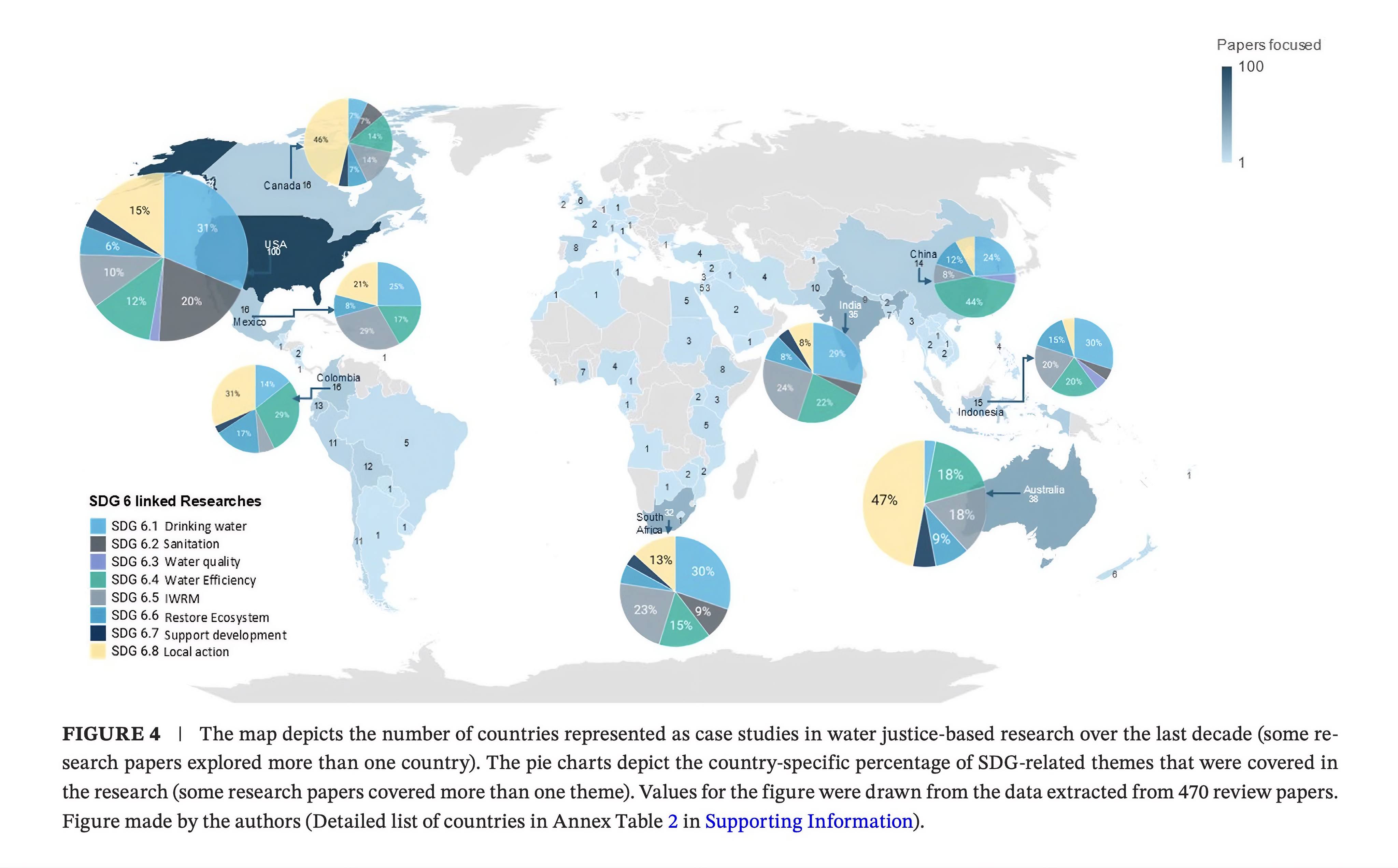
The review's sharpest finding: across 470 studies, the diagnosed barriers — power asymmetry, institutional capture, policy misalignment — barely changed over the decade. What changed were the proposed responses.
The first period (2012–2014) emphasized decentralization and participation. The second (2015–2019) pushed structural reforms and plural approaches. The most recent (2020–2023) organized itself around co-governance, Indigenous sovereignty, and an "ethics of care."
That evolution means something. But the vast majority of studies diagnosed; they didn't treat. Studies documenting what actually works exist — but they're exceptions, not a pattern. And gains aren't permanent: when political leadership shifts or budgets tighten, most progress reverses.
"Sufficient access" statistics can hide everything
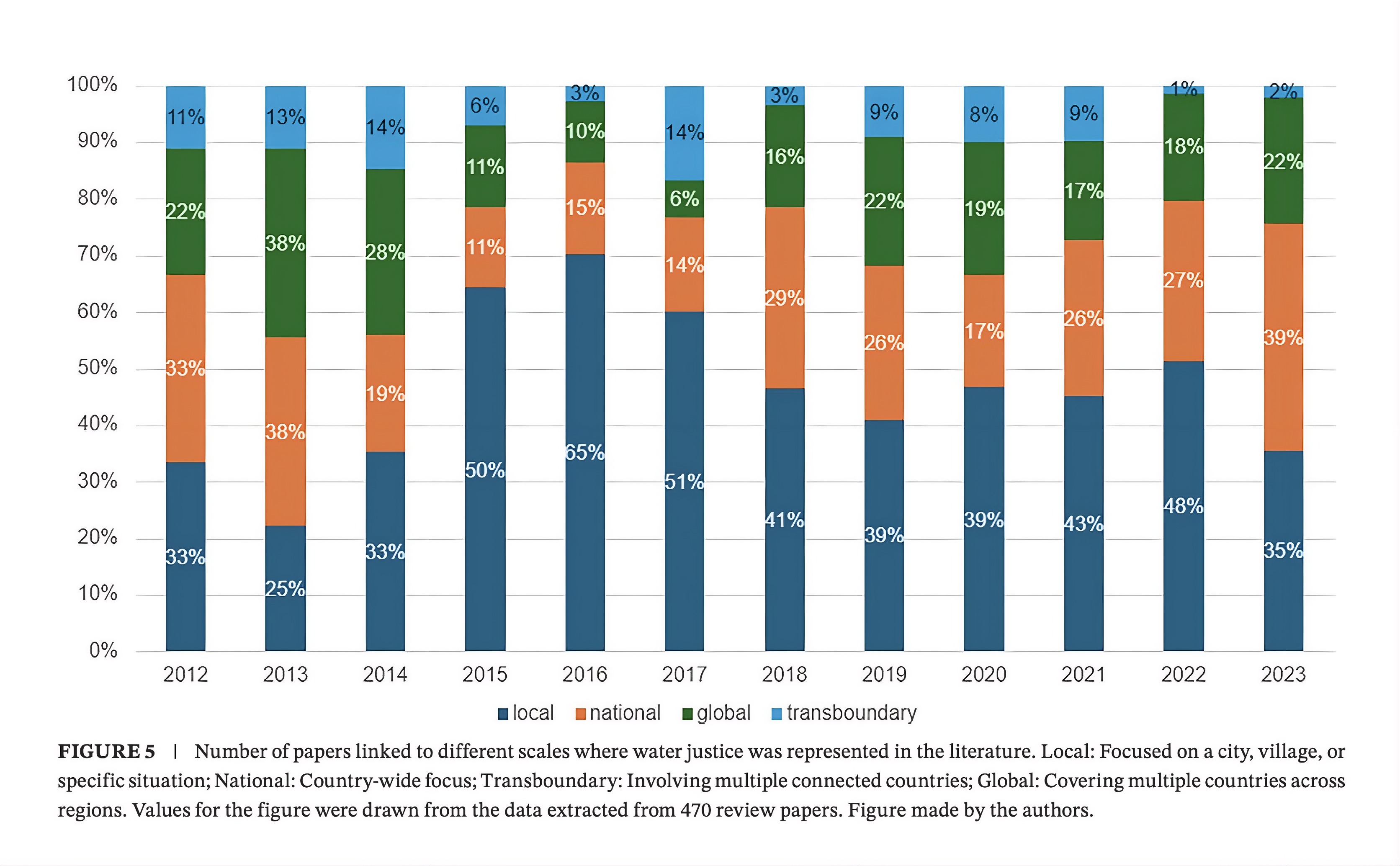
The United States leads the literature with 100 studies — by a wide margin. Much of that research makes the same point: official indicators can look fine while deep inequalities run underneath. Ninety-seven percent of the US population has access to improved drinking water, the numbers say. But what that access means depends heavily on what neighborhood you live in, and what that neighborhood looks like.
Flint became the symbol. But Flint wasn't an exception — it was a visible example of something far more common.
The cost of activism stays invisible
There's something the paper flags that the broader academic literature largely ignores: people fighting for water justice burn out. Years-long legal battles, institutional resistance, social ostracization, sometimes physical danger. These are real costs absorbed by individual activists and communities. The support structures to help them carry that weight are nearly nonexistent.
The core question hasn't changed
The paper argues that SDG 6 — "water and sanitation for all" — is most often framed as a technical problem. More infrastructure, more investment, more efficient systems. But a decade of research has shown that framing falls short, repeatedly.
Water insecurity is a problem of power more than a problem of pipes.
Who decides, who benefits, who pays the cost — without asking those questions, you can lay down as much infrastructure as you like and the structure doesn't change.
The conceptual expansion is encouraging. The deepening diagnosis is valuable. But ten years of literature also say this: naming injustice and dismantling it are not the same thing.